Sickle Cell Disease Patients dying from Opiates: Why no co-operation among doctors?

I am very concerned at what appears to be inadequate cooperation among medical practitioners who I had always assumed worked in harmony to improve the quality of patients' lives and save lives that can be saved.

If I have understood correctly, in the first few years of training, medical practitioners learn that opiates, notably morphine and heroin (Diamorphine) have an effect on the cerebellum and deprive the system of oxygen. It is therefore advised that as there are numerous alternatives available, they should absolutely not be used as a pain killer unless a patient is terminally ill, very near to death and in excruciating pain which no other pain killer can relieve.

Do I understood that those physicians who continue to prescribe these drugs have forgotten what they have been taught or choose to ignore the fact even when reminded? What is happening to the life-saving dictum of the profession where some doctors are concerned?

In November 2008, I went to an emergency room at a clinic in Geneva , Switzerland where I live, with a blasting chest pain. My condition was soon further complicated by excruciating pain in my left hip.

My new lease on life is because medical practitioners did not contest my refusal of a morphine injection to relieve excruciating pain in my chest and hip. The physicians attending to me would have loved to relieve me of the pain with morphine but respected the knowledge, however little, and understanding I had of the way in which opiates affect the brain and therefore the entire system. They deprive the system of oxygen which is desperately vital in my condition, Sickle Cell Disease.

I had double pneumonia and pleurisy. The infection had provoked a sickle cell crisis. Before they had realised the extent of my illness, the fact that I was a sickle cell disease (SC) patient was enough for the physicians attending me NOT to insist on administering morphine. One of them said that my pain had reached the maximum the human body could endure.

Unfortunately, some physicians force patients to have morphine. Whether one is a sickle cell patient or not, opiates in my opinion, are not to be recommended.

I am allergic to aspirin and therefore must avoid no fewer than 34 prescription and over-the-counter medications, including Ketorolac (Toradol) which is very effective in relieving excruciating pain.

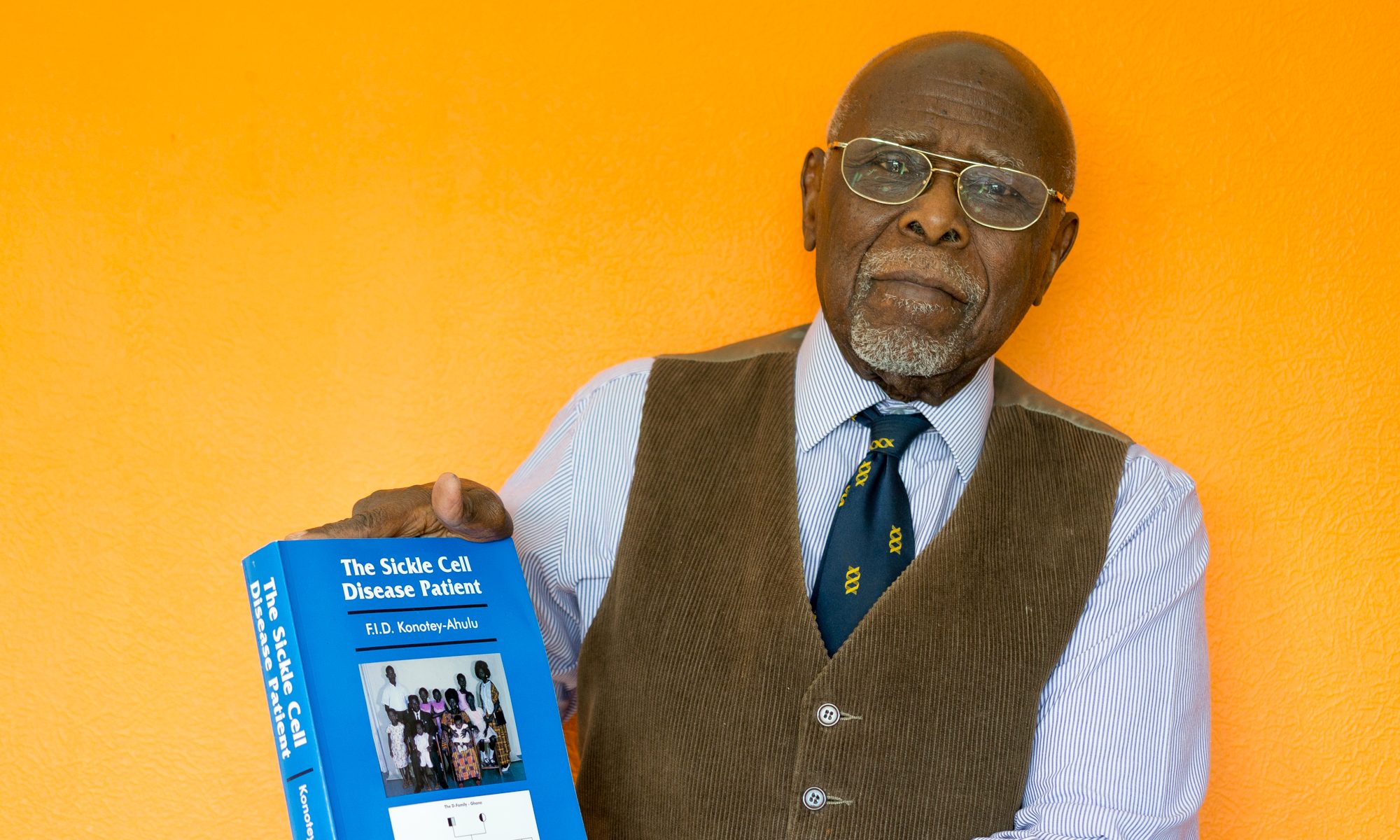
There are so many misconceptions about sickle cell disease that I took the book “The Sickle Cell Disease Patient” by F I D Konotey-Ahulu to the clinic and my daughter handed it to the physician attending to me. My three adult children are well informed about my health issues and therefore telephoned Professor Felix Konotey-Ahulu abroad for guidance. My physicians were very happy to consult with him by telephone. He confirmed that I was right to refuse the administration of morphine and together they co-operated in making me comfortable and well again.

I was fortunate enough not to need a blood transfusion (neither total nor partial).

It may help medical practitioners to know that over the 12-days that I was in the clinic in Geneva, medication I was given was Dafalgan, Valium, Tramal, Perfalgan, Rocephine, Klacid, Franxiperine, Nexium and Tavanic and Motilium lingual. I also had Oxygen, NaCl and Glucose. No Morphine or Diamorphine!

On leaving the clinic in Geneva , I went to a convalescence clinic. A physician at the convalescence clinic asked why I had refused morphine. When I explained why, a colleague of his pointed to the back of his head, reminding him of the effect opiates have on the brain.

I am privileged to interact with physicians for whom I have the highest respect, one reason being because they take due consideration of what I, their patient, say and they listen to my children as well. The physicians are humble enough to take hold of a receiver and cooperate with another physician abroad in saving a life. They admit to me that they have been very happy to deepen their knowledge and would be pleased to learn more.

Had I been given the morphine or any other opiate, because of my double pneumonia with sickle cell disease, I would not be writing today, pleading with physicians to have compassion on patients who sometimes suffer very uncomfortable psychological problems (however temporary) as a result of having been given opiates and those who die as a result of having been given opiates.

The physicians who seem not to understand should try putting themselves in the position of families plunged into unbearable grief because of carelessness – a loved one was given opiates unnecessarily.

In spite of myself I begin to wonder whether Professor Felix Konotey- Ahulu's very practical and uncomplicated life-saving advice is being ignored by some medical practitioners because of his African origins. I believe his advice is based on what every medical practitioner learns at medical school.

Mawunu Chapman Nyaho
Geneva

Competing interests: None declared

Source : http://www.bmj.com/cgi/eletters/339/sep01_1/b3536#220670

UK drug related deaths are still rising: So where is NICE?

http://www.bmj.com/cgi/eletters/339/sep01_1/b3536#219836

Susan Mayor, 5 September, has done well to draw attention to 2 reports that reveal “the numbers of people dying because of poisoning from legal and illegal drugs are still increasing” [1] The first report said “Almost a third of the deaths where specific drugs were mentioned on the death certificate were related to heroin or morphine” [1, 2] The second report from St George’s University of London showed a 2.7% rise in the number of drug related deaths confirmed by inquest. Here too “Heroin and morphine accounted for most of these deaths” [3]. And these were the very drugs that the NCEPOD Report [4] found had produced deaths in sickle cell disease patients from overdose, and about which I continued to protest [5- 8].

HOW LONG WILL THIS CONTINUE FOR?

How long this situation is destined to continue is not clear. Writing to the Prime Minister and Health Ministers as I did, produced a response from Downing Street [6], but other ministers did not even bother to acknowledge my letters of concern. The United States of America has banned Diamorphine (Heroin) from all clinical practice [9], and that great country does not even have a National Institute of Health and Clinical Excellence (NICE). I would dearly want to know what percentage of the members of NICE are practicing Clinicians. Do they not know that Diamorphine suppresses respiration thus producing more in vivo sickling in sickle cell crisis [10, 11, 12]? Never mind how many UK Professors of Haematology approve of the practice, but do the Clinicians on NICE not know that it is this “legal” Diamorphine that (as Susan Mayor writes) is pushing up “the numbers of people dying because of poisoning from legal and illegal drugs” [1]?

IS MY PROTEST JUSTIFIED OR NOT?

But why do I continue protesting like this? ANSWER: First of all, I did not train in the bush somewhere in Africa. I was trained in London University’s Westminster Hospital School of Medicine by Physicians and Surgeons of King George VI and Queen Elisabeth II. My teachers taught me never to give Diamorphine or morphine to someone who could not breathe and whose red cells were bound to sickle further and clog up vital organs [13]. Secondly, I was second born of my parents’ 11 children 3 of whom had sickle cell disease, allowing me to know much about the disease before I went to university [14]. Thirdly, I was once in charge of the largest sickle cell disease clinic in the world, seeing personally hundreds of patients in sickle cell crisis [15, 16], salvaging many to grow up to use their brilliant non-sickling genes to achieve great things later in life, an experience which led me to begin writing about the sickle cell disease patient more than 44 years ago [17].

MY ADVICE TO NATIONAL INSTITUTE OF HEALTH AND CLINICAL EXCELLENCE

In the light of the above I make no apologies to take it upon myself to advise NICE to stop standing on the sidelines, and add to their many pronouncements one that forbids the “legal” use of Heroin (Diamorphine) for sickle cell disease patients. This, at least, was one thing NICE could learn from the USA [9].

GENETIC COUNSELLING AND VOLUNTARY FAMILY SIZE LIMITATION

The real answer for now, and the future, as I have been saying for decades is Genetic Counselling and Family Planning [18, 19] warning my fellow Africans that if they did not check themselves for a beta-globin gene variant (an ACHE gene) they might suddenly find themselves with a child born with an ACHEACHE phenotype (ACHE from father and ACHE from mother), like Sickle Cell Disease, and “the genetic burden on the National Health Service will go up and up” [20]. If born in the UK, the child could never escape Diamorphine treatment in sickle cell crisis. Was that really a prospect my country men and women would cherish?

Felix I D Konotey-Ahulu MD(Lond) FRCP DTMH Dr Kwegyir Aggrey Distinguished Professor of Human Genetics, University of Cape Coast, Ghana and Consultant Physician Genetic Counsellor in Sickle & Other Haemoglobinopathies, 10 Harley Street London W1G 9PF.

felix@konotey-ahulu.com

1 Mayor Susan. UK drug related deaths are still rising say two reports. http://www.bmj.com/cgi/content/full/339/sep01_1/b3536 BMJ 2009; 339: b3536

2 Deaths related to drug poisoning www.statistics.gov.uk/pdfdir/dgdths0809.pdf August 2009.

3 The St George’s Annual Report August 2009 www.sgul.ac.uk/about-st-georges/divisions/faculty-of-medicine-and- biomedical-sciences/mental-health/icdp/our-work-programmes/nationa/- programme-on-substance-abuse-deaths

4 NCEPOD (National Confidential Enquiry into Patient Outcome and Death). SICKLE: A Sickle Crisis? (2008) [Sebastian Lucas (Clinical Co- ordinator), David Mason (Clinical Co-ordinator), M. Mason (Chief Executive), D Weyman (Research), Tom Treasurer (Chairman)] info@ncepod.org

5 Konotey-Ahulu FID. Poor care for sickle cell disease patients: This wake up call is overdue BMJ Rapid Response May 28 2008 BMJ 2008; 336: 1152 http://www.bmj.com/cgi/eletters/336/7654/1152a#196224 to Susan Mayor “Enquiry shows poor care for patients with sickle cell disease” on National Confidential Enquiry into Patient Outcome and Death (NCEPOD) REPORT “SICKLE: A Sickle Crisis? (2008) info@ncepod.org

6 Konotey-Ahulu FID. Current “hit and miss” care provision for sickle cell disease patients in the UK. http://www.bmj.com/cgi/eletters/337/jul11_2/a771#199135 BMJ Rapid Response 22 July 2008

7 Konotey-Ahulu FID. Management of sickle cell disease versus management of the sickle cell disease patient. http://www.bmj.com/cgi/elettrs/337/sep08_1/a1397#202088 BMJ Rapid Response 17 September 2008

8 Konotey-Ahulu FID. Inquest into diamorphine deaths: Does NCEPOD sickle patients report warrant a similar inquest? BMJ Rapid Response March 7 2009 http://www.bmj.com/cgi/eletters/338/mar03_3/b903#210208

9 Ballas SK. Sickle Cell Pain. IASP Press. Seattle 1998.

10 . Konotey-Ahulu, FID. Morphine for painful crises in sickle cell disease. BMJ 1991, 302(6792): 1604. (June 29 1991) (Comment on Professor Chamberlain's recommendation of morphine in pregnancy in sickle cell disease – BMJ 1991; 302: 1327-30.) doi:10.1136/bmj.302.6792.1604-c http://www.bmj.com/cgi/reprint/302/6792/1604-c.pdf PMID: 1855060 PubMed- indexed for MEDLINE

11 Konotey-Ahulu FID. Opiates for sickle-cell crisis? Lancet 1998; 351(9113): 1438. May 9. PMID: 9593444 PubMed-indexed for MEDLINE

12 Konotey-Ahulu FID. Opiates for sickle-cell crisis. Lancet 1998; 352(9128): 651-652. Aug 22. PMID:9746049 PubMed-indexed to MEDLINE

13 Konotey-Ahulu FID. Opiates for pain in dying patients and in those with sickle cell disease. 11 October 2007 BMJ Rapid Response http://www.bmj.com/cgi/eletters/335/7622/685#177986

14 Konotey-Ahulu FID. Sickle Cell Disease in successive Ghanaian generations for three centuries (Manya Krobo Tribe) In The Human Genome Diversity Project: Cogitations of An African Native. Politics and the Life Sciences (PLS) 1999, Vol 18: No 2, pp 317-322. http://www.konotey- ahulu.com/images.generation.jpg

15 Konotey-Ahulu FID. The Sickle-cell Diseases: Clinical manifestations including the Sickle Crisis. Arch Inten Med 1974; 133(4): 611-619. http://archinte.ama.assn.org/cgi/reprint/133/4/611-pdf or http://archinte.ama.assn.org/cgi/content/abstract/133/4/611 [PMID: 4818434 PubMed – indexed for MEDLINE]

16 Konotey-Ahulu FID. The sickle cell disease patient: natural history from a clinico-epidemiological study of the first 1550 patients of Korle Bu Hospital Sickle Cell Clinic. Watford Tetteh-A’Domeno Company 1996 & The Macmillan Press Ltd, London 1991/1992.

17 Konotey-Ahulu FID. Publications annually from 1965 to 2009 http://www.konotey-ahulu.com/publications_annual.htm

18 Konotey-Ahulu FID. Sickle Cell Disease: The Case for Family Planning. Accra. ASTAB Books, Ltd 1973; 32 pages.

19 Ringelhann B, Konotey-Ahulu FID. Hemoglobinopathies and thalassemias in Mediterranean areas and in West Africa: Historical and other perspectives 1910 to 1997 – A Century Review. Atti dell’Accademia dell Science di Ferrara ( Milan) 1998; 74: 267-307.

20 Konotey-Ahulu FID. Need for ethnic experts to tackle genetic public health. http://www.thelancet.com/journals/lancet/article/PIIS0140- 6736(07)61771-1/fultext Lancet 2007; 370: 1836 [doi:10.1016/50140- 6736(07)61771-1]

Competing interests: None declared.

Sickle Cell Disease Patients dying from Opiates: Why no co-operation among doctors? Mawunu Chapman Nyaho

http://www.bmj.com/cgi/eletters/339/sep01_1/b3536#220670 British Medical Journal 21 September 2009